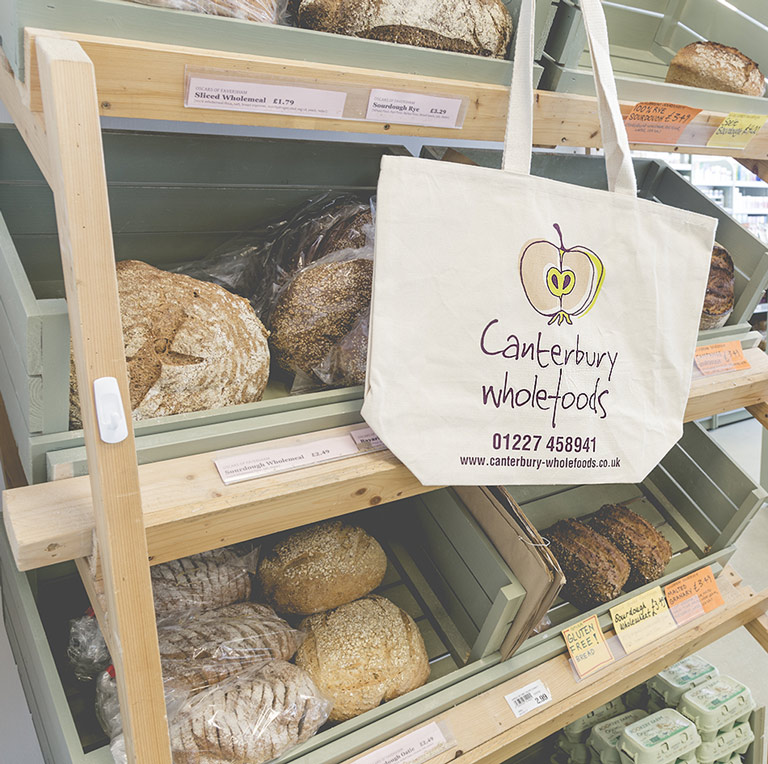
Balkan beats, jazz and folk music (played by Canterbury Wholefoods’ own Phil Holmes also of the bands Mr. Lovebucket & Lapis Lazui) greeted customers as they entered the store. Once in they were treated to curry from Chai Stop curries based in Minster, given skin care advice from therapist Raphaella Bellamondi and sampled the amazing olives and meze from Olives R good 4 U. Notwithstanding the delicious chocolate giveaways on the High St and in store by Plamil Chocolates from Folkestone.
Co-owners Roger Everatt & Martin Darling were available to meet new customers and share fond memories with established ones. Roger was tweeting updates on the day having learnt to tweet the pervious day. Roger said,”Best ever day at CWFoods – many thanks to everyone who pitched up. We’ll do something similar again soon just to keep the buzz going!”
The event lasted all day 9am to 6pm and was exceptionally busy throughout. “Canterbury has really taken this event and anniversary to their hearts. To everyone who has come down and said hello, shopped with us over the past 35 years, worked for us and helped make this shop what it is – an independent alternative, a true community shop – thank you” said co-owner Martin Darling.
Customers left with goodie bags worth £20+ with one shopper saying “It’s so generous, it’s all top stuff and varied, useful and lovely products!”
Strong – or hard – describes a flour with a high gluten content. Gluten is a protein present in all wheat but the amount varies according to how and where the crop is grown. It is also present in lesser amounts in rye, barley, and often in oats due to cross-contamination with wheat crops. The more warmth and sunlight hours the crop is exposed to the more gluten there is in the grain. Strong flour is best for bread-making because it is gluten that gives the dough its elasticity and helps the loaf to rise. Wheat crops with a low gluten content, such as those grown in the UK during a poor summer, will produce a rather solid, brick-like loaf with a tendency to crumble. Hard wheats from North America or Southern Italy, on the other hand, will encourage the dough to rise nicely, giving the bread a springy, well-aerated texture. The elasticity in Durum Wheat – a grain particularly high in gluten – is what makes it the perfect choice for pasta-making.

We are often asked if someone with a gluten intolerance can use Spelt flour in their diet. Spelt is, like wheat, a triticale, and shares many of the latter’s nutritional attributes. It contains a moderate amount of gluten, and Coeliacs cannot tolerate it, but for many with allergies and intolerances to common wheat it is a welcome replacement – if they are able to tolerate it. Unfortunately there is no way of finding out other than trying it! There are a number of theories about why Spelt is sometimes better tolerated than wheat but no conclusive research, unfortunately.
Another common question about flour. The answer is that there is no difference – the terms are interchangeable. These flours are usually stoneground – traditionally milled using the whole of the grain. Wholegrain flours that do not describe themselves as stoneground might well have been milled with a mechanical roller which removes the bran and wheatgerm. These flours are then bleached and the bran and wheatgerm returned to the flour.
White flour is often bleached so that the bread will have a bright and “pure” look. If you prefer your flour to have avoided this treatment, look for white flours that describe themselves as unbleached. The flour and subsequent loaf will be slightly darker and pale cream in colour compared to the bleached variety.
Soak, boil and simmer are the three stages. Soak for about 8 hours (overnight is ideal) to help soften the bean and reduce cooking times. Rinse in fresh water and then bring to the boil in water that comfortably covers them (they do swell during cooking). Make sure the beans are cooked at boiling point for a minimum of 10 minutes. This is to ensure that any toxic enzymes on the skins are destroyed, as well as the carbohydrates that can lead to bloating and flatulence. This is crucially important in the cases of Kidney Beans and Soya Beans. Then simmer until your teeth tell you they’re done. Ideally the bean should be al dente, easily bitten through but retaining good texture. Rinse again in fresh water and they’re ready to use. You don’t have to soak any pulse that has been split (often called dal or dahl), and lentils don’t need soaking either, split or otherwise.
Quinoa (pronounced keen-wah) is a tiny grain, similar in size to millet, and is an excellent dietary source of magnesium, phosphorous, iron and fibre. It contains all eight amino acids, making it a complete protein – something neither wheat or rice can boast of. It is often referred to as the Grain of the Incas, since it has been grown high in the Andes for many centuries. It is easy to cook – two parts water to one part Quinoa, bring to boil, simmer for 10 to 15 minutes. Use as you would cous cous or rice. It is also a great base for a salad. Try it with puy lentils, red onion and feta cheese, with a lime, olive oil, garlic and mustard vinagrette.